How The Other Side Was Built to Keep Players Investigating Long After the Fear Should Have Worn Off
Before diving into the design of The Other Side, a little background is probably helpful.
While The Other Side has spent the past year in Early Access with a team of two developers, it was largely built as a solo-project. Today, the team consists of one designer, and one engineer – an incredibly small team for a multiplayer horror game of this capacity. That limitation has forced us to think differently… Instead of trying to compete by creating “More ghosts! More Maps! More Everything!!!”, we focused on a much simpler question:
“How do you stop players from memorizing the game to the point where they’re no longer enjoying themselves?”
That question ultimately shaped almost every design decision we’ve made to date.
The Memorization Problem
The first time you play a paranormal investigation game, you’re terrified. Every noise makes you second guess whether or not to move forward, every light interaction feels like it could be dangerous, and every hunt is dangerous. By the fiftieth investigation….. Well, you’re no longer investigating, you’re optimizing. I myself am incredibly guilty of this. Players naturally begin memorizing evidence combinations, identifying signature ghost behaviors, and taking the fastest possible route to the correct answer. The mystery of the game disappears, and it’s all replaced by efficiency. There’s nothing inherently “wrong” with that – learning is a part of the fun. But, it also creates an unfortunate side effect…. Players often spend only a few minutes inside a location before confidently identifying the ghost, and leaving. Entire environments, interactions, and systems that took months to build are skipped because that “optimal” strategy is simply to finish as quickly as possible.
So, that begged the question:
As developers, what’s the point of building immersive locations, and unique ghost interactions if players never have a reason to experience them?
Instead of designing around speed, we wanted to design around curiosity.
From there, our goal actually became incredibly simple!
Make players investigate, rather than recall.
If players could solve every contract from memory, then we’ve failed.
Building a Better Investigation
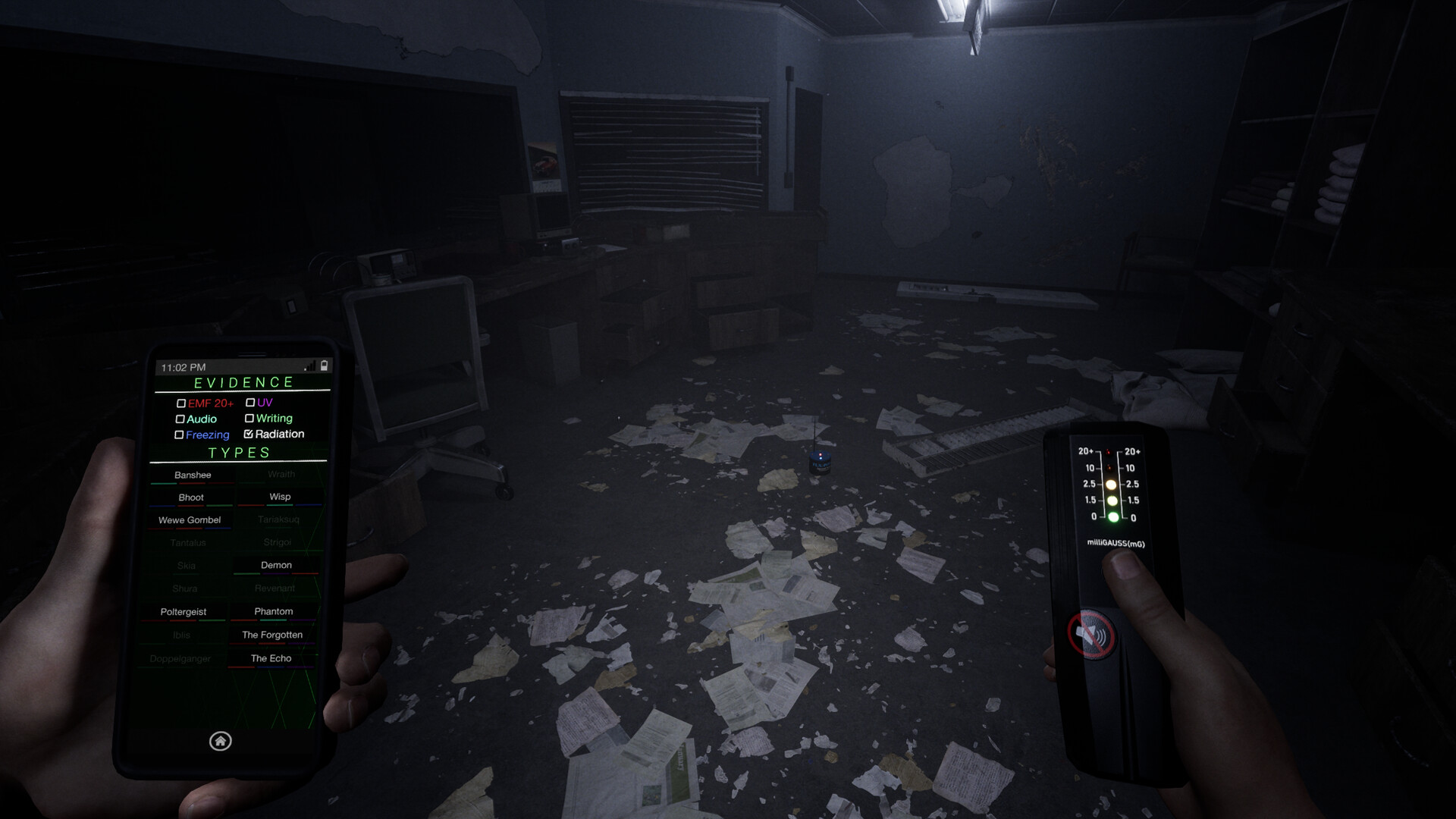
That philosophy largely carried over into Cleanse mode – what we joke is our “pride and joy”. Rather than ending the experience once players identify the ghost, Cleanse mode allows players to take it a step further, and exorcise the ghost entirely. The idea wasn’t to make the matches “last longer”, but to give players meaningful reason to stay engaged with the environment. Instead of asking a simple yes-or-no question like, “Is there UV?” players have to determine the strength of the UV. This is likewise for all of the evidence. Is the UV a faint spatter? Large concentration? Or full-on-handprints?
The same philosophy extends across multiple investigation tools – radiation isn’t just “present, or absent”, it varies in intensity. Temperatures aren’t just “freezing” or “not freezing”, players have to determine whether they’re mild, moderate, significant, or frigid.
These layered observations encourage players to gather information instead of checking boxes.
One of the larger differences from traditional paranormal investigation games was abandoning the idea that the ghost permanently occupies a single favorite room. Instead, our ghosts move naturally throughout the location, affecting the environment wherever they go. As they travel, temperatures drop in the rooms they’re currently in. Investigators equipped with a thermometer can literally track the ghost’s movement throughout the building, encouraging exploration instead of camping in one room, waiting for activity.
That single decision fundamentally changed how players interacted with our maps. Instead of waiting for the ghost, players now hunt the ghost.
While following its trail, investigators continue collecting evidence, surviving hunts, and piecing together the information needed to perform a successful cleanse.
Without diving too deep into it, the overall gameplay loop looks something like this:
1. Investigate the location and determine the highest-level characteristics the ghost leaves behind.
2. Record those findings into the Affixer
3. Perform a successful scan using the Affixer to reveal artifacts binding the ghost to the location.
4. Locate and remove the artifacts using special equipment.
5. Survive long enough to banish the ghost from the location.
The objective shifts from simply discovering what the ghost is, to understanding how the ghost is behaving.
Investigation Over Spectacle
That same philosophy carried over into our traditional Identify Mode. While every ghost in The Other Side has unique behaviors, we intentionally avoided making identification revolve around one obvious “giveaway.”
A Skia may cry near a player.
A Bhoot can cause temperatures to plunge below freezing shortly before a hunt.
A Demon may leave behind unexpected hot spots.
Those moments are exciting, but they aren’t the foundation of the investigation.
Instead, we wanted players to slowly build a case through dozens of subtle observations.
Can this ghost turn lights on?
Will it only turn lights off?
Does it interact with radios differently?
How does it manifest?
How quickly does it move during a hunt?
Individually, none of these observations identify a ghost, but together, they create a profile.
Rather than memorizing one dramatic behavior, players begin connecting patterns over time, making each investigation feel more like detective work than a checklist.
Why Replayability Matters
Replayability isn’t just about randomization, it’s about preserving uncertainty. The moment players know exactly what’s going to happen every time they enter a location, much of the fear disappears. We believe the best horror games keep players asking questions, even hundreds of hours later. For us, creating replayability wasn’t about making investigations harder. It was about making them impossible to completely memorize.
Looking Ahead
We’re incredibly proud of what we’ve accomplished with such a small team, but we also see The Other Side as an evolving project.
Every update is another opportunity to refine systems, deepen investigations, and create moments players haven’t experienced before. At the end of the day, this isn’t just a hobby project for us – it’s our livelihood, and it’s something we’re deeply passionate about. If there’s one lesson we’ve learned throughout development, it’s this: The most memorable horror games don’t ask players to remember the answers. They ask them to keep asking questions.